

Intro
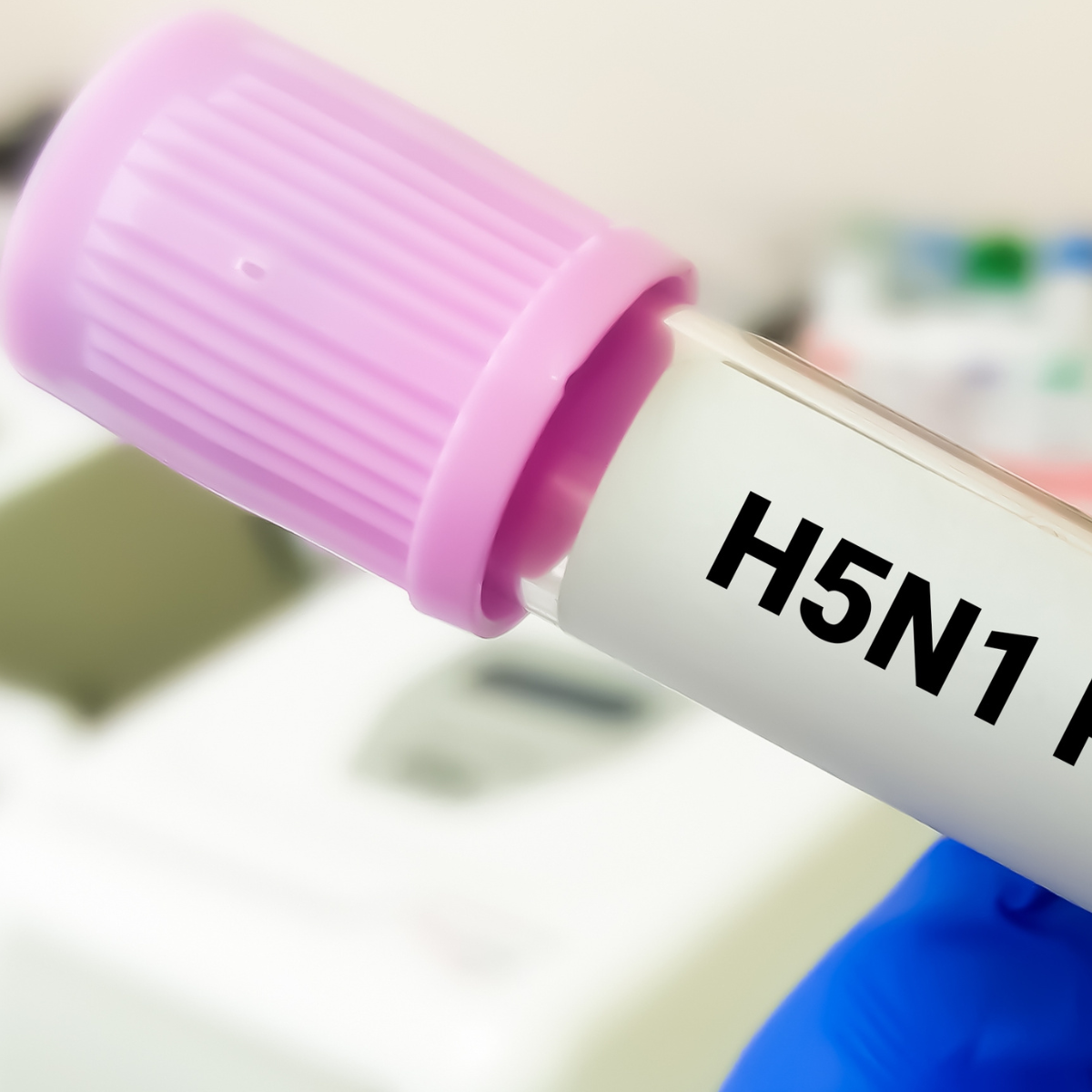
Highly pathogenic avian influenza A (H5N1) continues to require attention from UK diagnostic and surveillance laboratories. While sustained human-to-human transmission has not been observed, the virus remains present in wild birds and poultry, and occasional human infections continue to be reported. These factors mean laboratories must be prepared to handle suspected H5N1 samples safely and reliably.
For laboratory managers and senior scientists, the main challenge is a practical one. Samples are often collected outside specialist containment facilities, moved between sites, and processed under time pressure. The choices made at the point of collection, particularly around transport media and storage conditions, affect both staff safety and the quality of molecular test results.
Many frontline influenza detection workflows in the UK rely heavily on molecular methods such as RT-PCR. These methods detect viral RNA rather than live virus. As a result, sample handling practices that focus on RNA preservation and early virus inactivation are often more relevant than those designed to keep the virus viable for culture. For an enveloped virus such as H5N1, this has clear implications for how samples are collected, transported, and processed.
This technical overview looks at H5N1 sample handling from a practical laboratory perspective. It describes current UK workflows, outlines common biosafety and diagnostic issues, and sets out what an effective transport medium needs to do for high-risk influenza samples. It then explains how Primestore® Molecular Transport Medium (MTM) fits into this picture as supporting infrastructure.
H5N1 Avian Influenza: Current UK Context
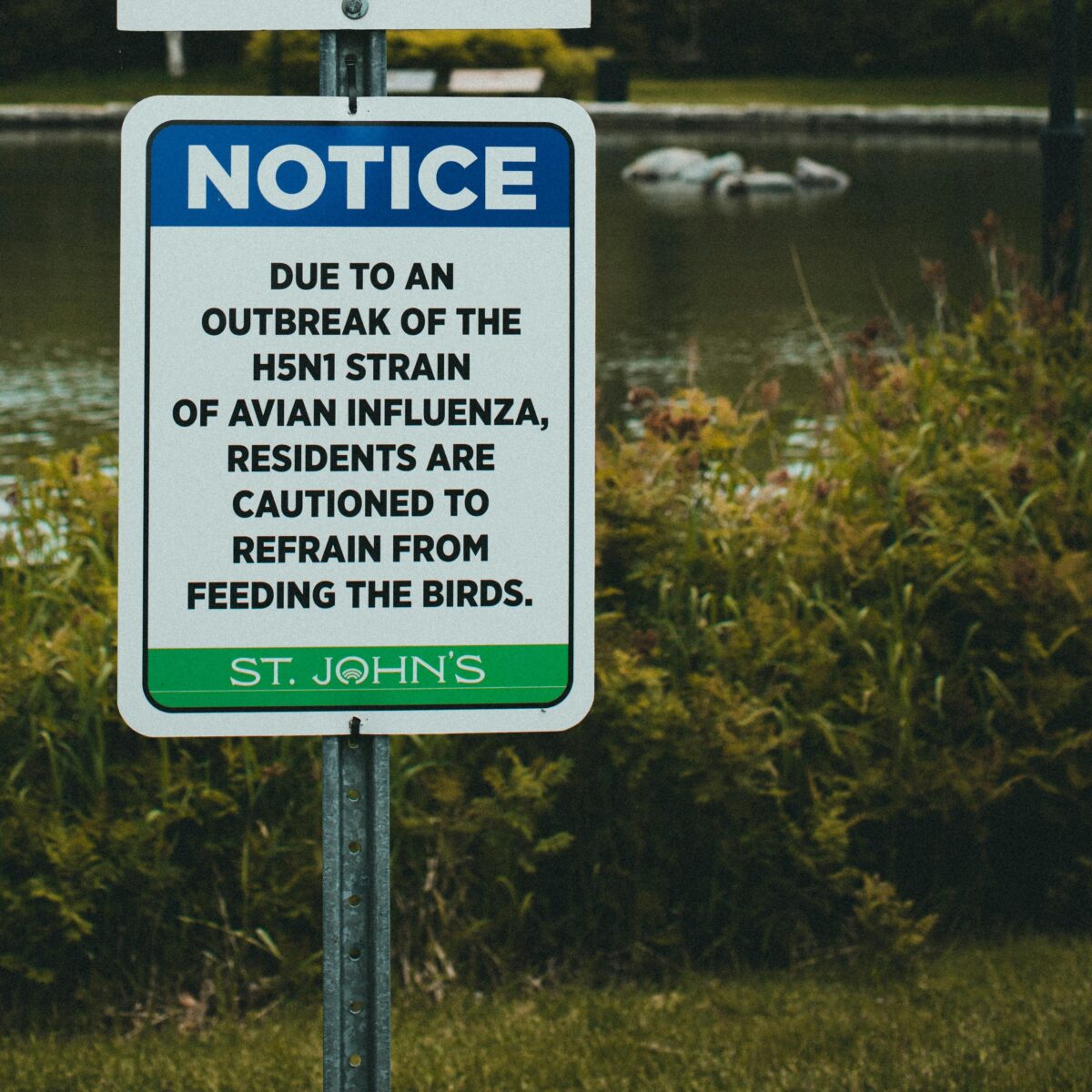
H5N1 avian influenza is now a regular part of avian disease monitoring in the UK. Large outbreaks in wild birds and poultry have led to ongoing surveillance and testing. Human infections remain uncommon, but the severity of disease when it does occur means laboratories must handle suspected samples carefully.
Sample collection usually takes place on farms, in wildlife settings, or during veterinary investigations. Samples are then sent to regional or national laboratories for molecular testing. This often involves several handovers, variable transport times, and mixed levels of infrastructure.
Cold storage during transport is not always straightforward. During periods of increased testing, maintaining refrigeration or freezing can be difficult. Reviews of viral specimen transport emphasise that molecular workflows remain vulnerable to transport and storage conditions, and that ambient-capable media are being developed to reduce dependence on strict cold chain for nucleic-acid testing [1].
Turnaround time also matters. Test results guide animal health decisions, staff exposure management, and communication with other organisations. Delays caused by transport issues or poor sample quality can slow these decisions.
Because of this, laboratories increasingly focus on the early steps in the process, especially how samples are collected and transported, rather than only on the analytical stage.
Diagnostic and Biosafety Challenges in H5N1 Sample Handling
Handling suspected H5N1 samples raises a practical problem. Traditional viral transport media keep the virus alive so it can be cultured. This approach makes sense for virology laboratories that plan to isolate the virus, but it also means samples remain infectious throughout transport and processing.
For highly pathogenic influenza viruses, this creates additional handling risk. Samples may pass through several hands before testing begins. Staff may need to open and process primary containers in laboratories that do not routinely work at high containment.
Molecular testing does not require live virus. RT-PCR and sequencing need intact RNA. From a safety point of view, it is better if the virus is inactivated as early as possible. From a testing point of view, RNA must remain stable after inactivation.
Studies using denaturing or chaotropic transport solutions show that it is possible to inactivate the virus and still recover RNA for PCR, which can reduce risk to laboratory staff [2]. However, not all inactivating solutions preserve RNA equally well, especially if transport times are long or temperatures vary.
Research on influenza virus survival shows that the virus can remain infectious under many environmental conditions [3]. Data specific to H5N1 in raw milk also show that moderate temperatures alone do not reliably inactivate the virus in that matrix [4]. This limits how much safety can be achieved through temperature control alone.
Risk is greatest when samples are first opened and processed. Opening tubes, transferring liquids, and loading extraction instruments all involve direct contact with the sample. During busy periods, small risks add up.
Finally, variation in how samples are taken, stored, and transported affects RNA quality. For a virus that may be present at low levels, protecting RNA is essential to avoid false-negative or uncertain results.
Requirements of an Effective Transport Medium for High-Risk Influenza Samples
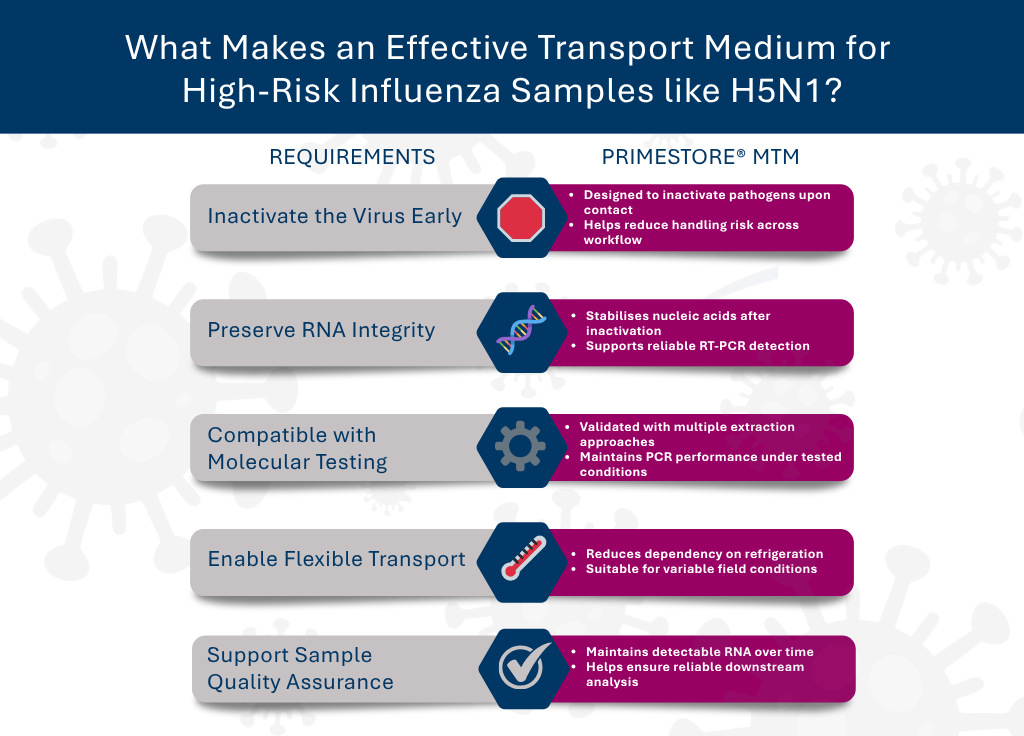
A transport medium for H5N1 samples that are intended for molecular testing needs to do several things well.
Inactivate the virus. Influenza A viruses have a lipid envelope that is sensitive to chemical disruption. Reviews of influenza virus survival show that breaking this envelope is an effective way to reduce infectivity [3]. Early inactivation lowers the risk during transport and handling.
Preserve RNA. Once the virus is disrupted, RNA is exposed. Influenza RNA degrades easily if RNases are present or if temperatures rise. Comparative studies of transport media show that media composition can materially affect nucleic-acid recovery and PCR performance, even though much of the direct evidence comes from SARS-CoV-2 workflows rather than H5N1 [5].
Work with molecular tests. Transport media should not interfere with RNA extraction or PCR. Some commonly used media reduce PCR efficiency or introduce inhibitors in tested workflows, which can affect analytical sensitivity [5].
Allow flexible transport. Reviews of viral sample transport increasingly point to the limits of relying on cold chain alone, especially during field work or high-volume testing [1]. Media that tolerate ambient temperatures reduce pressure on logistics.
Support quality checks. Being able to assess whether a sample remained intact from collection to testing helps laboratories interpret negative or borderline results.
Taken together, the transport medium used affects safety, sample quality, and test results.
Primestore® MTM in the Context of H5N1 Diagnostics

Primestore® Molecular Transport Medium (MTM) was designed for molecular testing where virus inactivation and RNA preservation are both required.
Peer-reviewed evidence supports Primestore® MTM as an inactivating, RNA-preserving transport medium in several relevant molecular workflows. Welch et al. reported >99.99% inactivation of a panel of surrogate or representative animal viruses, including low-pathogenic avian influenza strains selected as surrogates for highly pathogenic avian influenza, while qRT-PCR detection remained comparable under the tested conditions [6]. This is relevant to H5N1 preparedness, but it is not the same as direct validation in clinical H5N1 field specimens.
Older published work also reported complete inactivation of laboratory-spiked H5N1 virus, preservation of influenza A RNA for RT-PCR after ambient storage, amplification of larger influenza gene fragments after heat challenge, and compatibility with several tested silica- and bead-based extraction kits [8]. These findings support analytical feasibility in specific workflows, but they do not establish universal compatibility with all extraction platforms or all downstream sequencing methods.
A separate 2025 study showed that Primestore® MTM inactivated several high-consequence viruses in spiked blood specimens at high titres [7]. That study strengthens the broader biosafety argument for the medium, but it was not an influenza study and should not be presented as direct H5N1 evidence.
For H5N1 workflows that rely on molecular detection rather than virus isolation, the published evidence supports Primestore® MTM as a plausible pre-analytical option for reducing viable-virus handling while preserving material for RT-PCR-based testing. Any use in a given laboratory still requires specimen-specific workflow validation.
UK-Relevant Use Cases and Workflow Integration
In UK settings, an inactivating medium such as Primestore® MTM may fit some molecular-only workflows.
One example is field collection of avian swabs, immediate placement into an inactivating transport medium, ambient transport to a laboratory, followed by RNA extraction and RT-PCR. In this type of molecular-only workflow, earlier inactivation may reduce some transport and early handling risks while RNA preservation supports reliable testing.
For veterinary investigations that cover wide areas, reduced dependence on cold storage may simplify transport logistics. Reviews of ambient transport options note their value when sample numbers increase or where access to refrigeration is limited [1].
Inside laboratories, compatibility with several tested extraction platforms may allow integration without rebuilding every pre-analytical step, although this still needs to be confirmed locally for the exact extraction kit and specimen type in use [8].
In multispecies surveillance or research settings, early inactivation may simplify some aspects of sample handling, but this is an operational inference rather than a finding established directly in the cited H5N1 literature. It does not replace risk assessment or local biosafety controls.
It remains important to match the transport medium to the testing goal. Where virus isolation is required, a non-inactivating medium is still necessary.
Implications for Laboratory Preparedness and Biosafety Strategy
Preparing for H5N1 involves more than choosing a test. It involves deciding how samples move through the laboratory and how risk is managed at each step.
Using a transport medium with published inactivation data can support lower-risk downstream handling after sample collection, but it does not remove the need to assess specimens within the laboratory’s own biosafety framework. Decisions about containment, processing location and workflow controls still need to be made locally.
From a governance point of view, published evidence on virus inactivation and RNA preservation can strengthen risk assessments. Each laboratory still needs to validate its own workflows, specimen types and extraction methods rather than assuming that a result transfers unchanged from one study setting to another.
Clear controls also help staff. When people understand why a sample is considered lower risk and how that risk was reduced, confidence improves and practices are more consistent.
No transport medium removes the need for training, containment, and oversight. However, the right pre-analytical choices can support safer and more reliable work.
Conclusion: Supporting Safe and Reliable H5N1 Diagnostics
H5N1 continues to place practical demands on diagnostic laboratories. Safe handling and reliable results both depend on decisions made before testing begins.
As molecular methods dominate many influenza testing pathways, inactivating transport media that preserve RNA may be better aligned with molecular workflows than media designed to maintain viability for culture, provided their limits are understood.
Peer-reviewed evidence [6-8] supports the use of Primestore® MTM as potentially useful supporting infrastructure in molecular workflows relevant to H5N1 preparedness. The strongest direct support is for pathogen inactivation and maintenance of RT-PCR-detectable nucleic acid under tested conditions, rather than for universal sequencing compatibility or validated performance across all H5N1 specimen types.
For laboratory managers and senior scientists, the task is not to find a single solution, but to build workflows that remain safe and reliable under everyday conditions. Thoughtful use of inactivating, RNA-preserving transport media can support that goal in UK H5N1 diagnostics.
Get in touch by filling in the form below with any questions or to request a quote for Primestore® MTM.
References
- Dsa OC, Kadni TS, Sudheesh N. From cold chain to ambient temperature: transport of viral specimens-a review. Ann Med. 2023;55(2):2257711. doi:10.1080/07853890.2023.2257711.
- Carvalho AF, Rocha RP, Goncalves AP, et al. The use of denaturing solution as collection and transport media to improve SARS-CoV-2 RNA detection and reduce infection of laboratory personnel. Braz J Microbiol. 2021;52(2):531-539. doi:10.1007/s42770-021-00469-4.
- Weber TP, Stilianakis NI. Inactivation of influenza A viruses in the environment and modes of transmission: a critical review. J Infect. 2008;57(5):361-373. doi:10.1016/j.jinf.2008.08.013.
- Nooruzzaman M, Covaleda LM, de Oliveira PSB, et al. Thermal inactivation spectrum of influenza A H5N1 virus in raw milk. Nat Commun. 2025;16(1):3299. doi:10.1038/s41467-025-58219-1.
- Kirkland PD, Frost MJ. The impact of viral transport media on PCR assay results for the detection of nucleic acid from SARS-CoV-2. Pathology. 2020;52(7):811-814. doi:10.1016/j.pathol.2020.09.013.
- Welch JL, Shrestha R, Hutchings H, et al. Inactivation of highly transmissible livestock and avian viruses including influenza A and Newcastle disease virus for molecular diagnostics. Front Vet Sci. 2024;11:1304022. doi:10.3389/fvets.2024.1304022.
- Spruill-Harrell B, Kocher G, Boda M, et al. Successful inactivation of high-consequence pathogens in Primestore® Molecular Transport Media. Viruses. 2025;17(5):639. doi:10.3390/v17050639.
- Daum LT, Worthy SA, Yim KC, et al. A clinical specimen collection and transport medium for molecular diagnostic and genomic applications. Epidemiol Infect. 2011;139(11):1764-1773. doi:10.1017/S0950268810002384.
Enquire about this article
"*" indicates required fields
