

A laboratory decision guide to faster workflows for symptomatic patients and partners of known SMA carriers
Spinal muscular atrophy (SMA) testing has to answer different clinical questions depending on the patient. For a symptomatic patient, establishing SMN1 exon 7 copy number quickly can be particularly important, while testing the partner of a known SMA carrier may focus on SMN1 copy number and residual carrier risk.
Multiplex ligation-dependent probe amplification (MLPA) remains an established method for SMA copy-number testing and has an important role in many laboratories. However, a PCR/CE-based approach such as the AmplideX® SMA Plus Kit could provide a useful alternative for selected testing pathways, particularly where a faster, streamlined workflow is desirable.
Rather than replacing an established MLPA service altogether, laboratories could consider where AmplideX® SMA Plus might offer a practical advantage.
What does the AmplideX® SMA Plus Kit offer?
The AmplideX® SMA Plus Kit from Asuragen combines SMN1 and SMN2 exon 7 copy-number analysis with detection of additional variants associated with SMA carrier risk and disease phenotype, within a single-tube PCR/CE workflow. The assay can also identify SMN1/SMN2 hybrid gene signals. The kit includes the calibrator, control and PCR reagents required for the assay, with automated analysis and reporting through AmplideX® Reporter software. [3]
For laboratories, however, the attraction is not simply the number of results generated. The workflow is designed to make SMA testing relatively straightforward:
- Less than four hours from purified DNA to analysed results
- Single-tube PCR for copy-number and variant analysis
- Automated analysis using AmplideX® Reporter software
- An included calibrator and control, with a fixed requirement per batch
- Capacity for up to 94 patient samples per run
- Compatibility with commonly installed Applied Biosystems® (ABI) CE instruments
- A familiar workflow for laboratories already using other AmplideX® assays [3]
The less-than-four-hour figure refers specifically to the workflow from purified DNA through to analysed results and excludes pre-analytical processing, clinical review and reporting. [3] It should not be interpreted as meaning that a sample can be received, tested and reported clinically within four hours, since pre-analytical processing, laboratory procedures and clinical authorisation will vary.
Where could AmplideX® SMA Plus fit alongside MLPA?
MLPA is well established in SMA testing, and there are good reasons for laboratories to retain an existing MLPA workflow where it meets their requirements. Existing validation, staff expertise and the breadth of information provided by a particular MLPA probemix all need to be considered.
AmplideX® SMA Plus offers a different approach. Its combination of copy-number and variant analysis in a single PCR/CE workflow may be particularly useful when speed, workflow simplicity or additional carrier-related information are priorities.
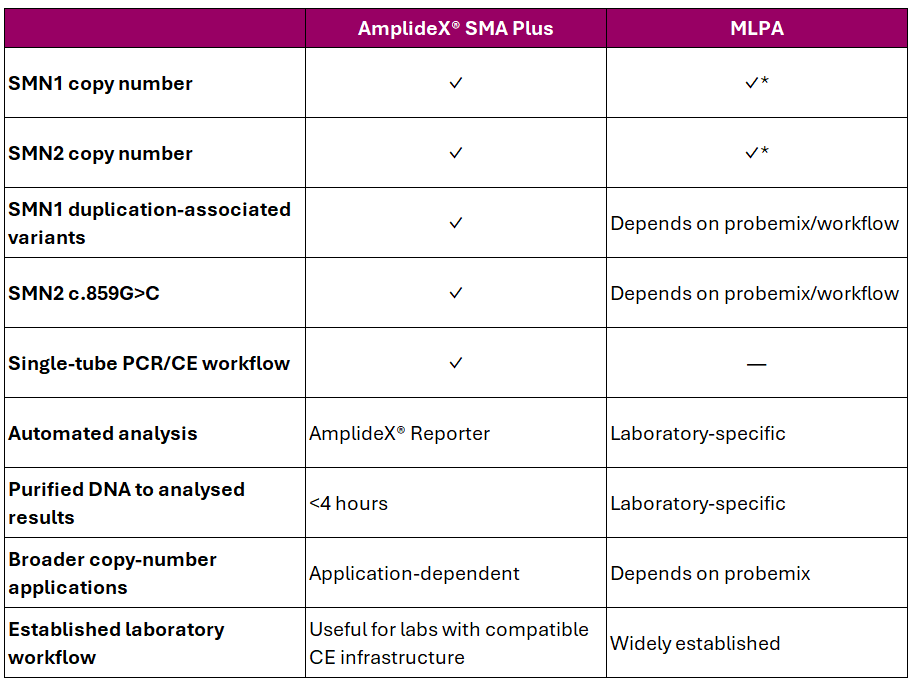
Table 1. Comparison of key capabilities and workflow characteristics of AmplideX® SMA Plus and MLPA for SMA testing. AmplideX® SMA Plus combines SMN1/SMN2 copy-number analysis with additional variant detection in a single-tube PCR/CE workflow, while MLPA capabilities vary according to the probemix and laboratory workflow. [1-3]
*MLPA capabilities depend on the specific probemix and laboratory workflow.
The key point is that the SMA Plus assay does not need to replace every MLPA application to be useful. A laboratory could introduce it for selected pathways while retaining MLPA where its broader or established capabilities remain appropriate.
Symptomatic patients: when turnaround time matters
For a patient with clinical features suggestive of SMA, the primary diagnostic question is whether there is biallelic loss of SMN1 exon 7. SMN1 copy number is therefore the critical result.
If SMA is confirmed or strongly suspected, SMN2 copy number can provide additional information relevant to disease phenotype and clinical interpretation. The SMN2 c.859G>C variant may provide further disease-related information in appropriate circumstances. [1]
The AmplideX® SMA Plus workflow can generate SMN1 and SMN2 copy-number results alongside relevant variant information in the same PCR/CE assay. This may be particularly useful where rapid, streamlined analysis of symptomatic patients is a priority. [2,3]An important limitation should be kept in mind: AmplideX® SMA Plus does not detect all pathogenic variants in SMN1. In particular, it does not identify SMN1 nonsense, frameshift or missense variants. As these account for a proportion of SMA cases, complementary SMN1 sequencing may be required where the clinical picture remains suggestive of SMA but the exon 7 copy-number result does not provide a diagnostic explanation.
Partners of known SMA carriers: assessing residual carrier risk
Partner testing presents a different challenge. An individual with one SMN1 copy is generally considered a carrier, but having two SMN1 copies does not completely exclude carrier status. Some individuals have both copies on the same chromosome, creating a 2+0 configuration, meaning they can be silent carriers.
AmplideX® SMA Plus detects the SMN1 duplication-associated variants c.*3+80T>G and c.211_212del, alongside SMN1 copy number. These markers can provide additional information when assessing residual carrier risk in someone with two SMN1 copies. [1,2]
Importantly, these variants do not prove or completely exclude a 2+0 genotype. Their contribution to residual risk depends on factors including ancestry and the relevant population data, so results should be interpreted alongside the individual’s clinical and family context.
For laboratories handling partner-of-known-carrier requests, combining SMN1 copy number with duplication-associated variant analysis in the same PCR/CE workflow can therefore provide additional information for residual-risk assessment. [1,2]
What does the evidence show?
The Milligan et al. study assessed assay performance through three separate components: an analytical accuracy study, a multisite evaluation across four external laboratories and a within-laboratory precision study. The main findings are summarised in Table 2. [2]
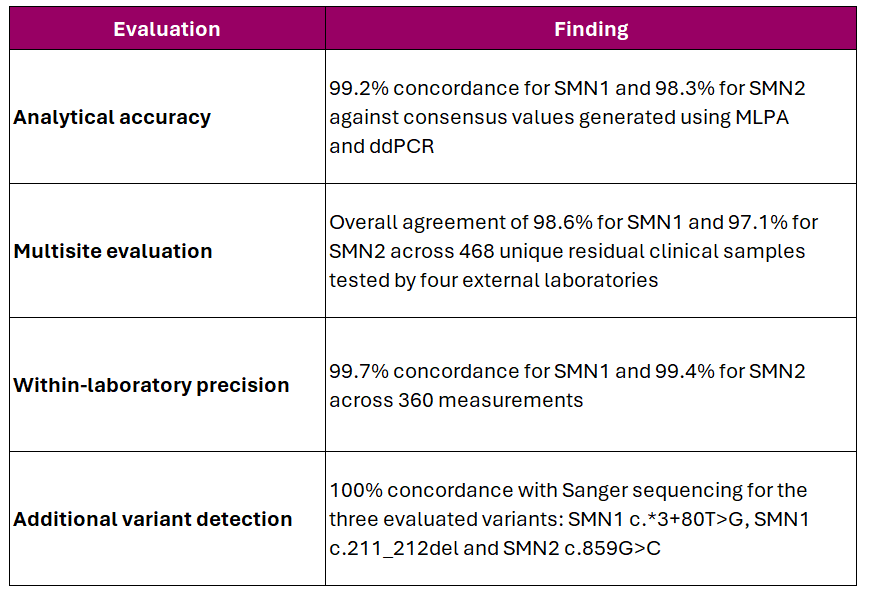
Table 2. Summary of the analytical performance evaluations reported by Milligan et al. [2] Taken together, these separate evaluations support the analytical performance and reproducibility of the PCR/CE approach across different testing conditions.
An additional capability: SMN1/SMN2 hybrid genes
Because SMN1 and SMN2 share more than 99.9% sequence identity, gene-conversion events between the two genes can complicate analysis.
The AmplideX® SMA Plus assay can identify hybrid gene peaks and incorporate these into its SMN1 or SMN2 exon 7 copy-number calculations. [2] This is a useful additional technical capability, but the Milligan study notes that hybrid-gene detection was not considered independently clinically significant for routine carrier or diagnostic interpretation, where exon 7 copy numbers are the key measurements. [2]
For this reason, hybrid-gene detection is best viewed as an additional capability of the assay rather than a primary reason for changing an established SMA testing workflow.
Could AmplideX® SMA Plus selectively replace MLPA?
For many laboratories, the answer may be yes for particular testing pathways, rather than across the entire SMA service. A laboratory could, for example, retain MLPA for established applications where it provides the required breadth of copy-number analysis, while using AmplideX® SMA Plus for:
- Symptomatic patients
- Where rapid SMN1 exon 7 copy-number results are important and a streamlined workflow could support faster analysis.
- Partners of known SMA carriers
- Where SMN1 copy number and duplication-associated variants can provide additional information about residual carrier risk.
The practical case for introducing SMA Plus is strongest where these specific testing requirements align with the assay’s workflow advantages.
Why consider a change to the workflow?
For laboratories already equipped with compatible ABI CE instrumentation, the practical case for introducing AmplideX® SMA Plus lies in combining copy-number and relevant variant analysis within a single-tube workflow, supported by automated analysis through AmplideX® Reporter.
The assay can accommodate up to 94 patient samples per run and provides analysed results from purified DNA in less than four hours, with approximately 60 minutes of hands-on time. For laboratories already using other AmplideX® assays, the familiar workflow may also make implementation more straightforward. [3]
Conclusion
AmplideX® SMA Plus offers a potential alternative to MLPA for selected SMA testing pathways rather than a wholesale replacement for an established MLPA service.
Its clearest fit is likely to be where a laboratory wants faster SMN1 exon 7 copy-number analysis for symptomatic patients, or SMN1 copy number and duplication-associated variant analysis for partners of known carriers, within a streamlined PCR/CE workflow.
For laboratories considering a change, the decision should therefore be based on whether these capabilities address a specific need within their existing SMA service.
Interested in a faster SMA testing workflow?
VH Bio supplies Asuragen’s AmplideX® SMA Plus Kit in the UK and Republic of Ireland.
If your laboratory currently uses MLPA for SMA testing, contact VH Bio to discuss whether AmplideX® SMA Plus could complement or selectively replace parts of your existing workflow. Fill in the form below to get in touch with our team.
References and further reading
- Luo M, Liu L, Peter I, et al. Recommendations for Interpreting and Reporting Silent Carrier and Disease-Modifying Variants in SMA Testing Workflows. Genes. 2022;13(9):1657.
- Milligan JN, Larson JL, Filipovic-SadicS, et al. Multisite Evaluation and Validation of a Sensitive Diagnostic and Screening System for Spinal Muscular Atrophy that Reports SMN1 and SMN2 Copy Number, along with Disease Modifier and Gene Duplication Variants. The Journal of Molecular Diagnostics. 2021;23(6):753–764. doi:10.1016/j.jmoldx.2021.03.004.
- Asuragen, Inc. AmplideX® SMA Plus Kit. Product brochure. 2000-0142 rev. A.
Read more:
- Asuragen Whitepaper: Interpreting Variants with the AmplideX® PCR/CE SMN1/2 Plus and SMA Plus Kits
- Spinal Muscular Atrophy (SMA): Genetics, Diagnosis, Treatment, and the Promise of Newborn Screening
Enquire about this article
"*" indicates required fields
