

What to do when human reads dominate your sequencing data
You’ve prepared the libraries, completed the sequencing run and reviewed the data. The problem is immediately apparent: most of your reads map to the human genome, leaving far less microbial information than you expected.
This is a common challenge in saliva, dental plaque, mouth swabs and other host-associated samples. Human DNA can account for a substantial proportion of sequencing data from saliva and other oral samples.[1]
Sequencing deeper may produce more microbial reads, but it also means paying to generate more human reads. An alternative is to change the balance before DNA extraction by selectively reducing the human DNA background.
MolYsis™ provides several manual and automated approaches to host DNA depletion. The right choice depends on the sample, its condition, your existing extraction process and the type of analysis you intend to perform.
First confirm that host DNA is the problem
“Contaminating reads” can describe several different problems. Host DNA depletion is most likely to help when the unwanted reads map to the human genome and intact microbial cells remain available for recovery.
Before changing the laboratory workflow, establish:
- the percentage of quality-filtered reads mapping to the human reference genome;
- whether the human-read fraction is consistent across samples or concentrated in particular specimen types;
- how many usable non-human reads remain at your current sequencing depth;
- whether libraries are failing because of low microbial DNA input; and
- whether the unwanted signal is genuinely human rather than microbial DNA also found in extraction blanks.
The most suitable option therefore depends on the sample and the laboratory’s preferred workflow. Host depletion may improve a library dominated by human reads, but it will not solve index misassignment, environmental contamination or microbial DNA introduced by extraction reagents.
Where microbial biomass is low, extraction blanks remain essential. Reagent-derived microbial DNA can otherwise account for a substantial part of the apparent community.[2]
Why oral samples generate so many human reads
Oral samples are not necessarily low biomass. Saliva and plaque can contain substantial microbial populations. The difficulty is often the ratio of microbial DNA to human DNA.
A relatively small number of human cells can contribute a large quantity of DNA because the human genome is much larger than a typical bacterial genome. The resulting library may contain plenty of DNA overall while still providing poor microbial sequencing efficiency.
Three questions are therefore more useful than simply asking whether the sample is low biomass:
- How much microbial material is present?
- How much human DNA is present alongside it?
- How abundant are the organisms or sequences of interest?
A sample with reasonable microbial biomass may still benefit from host depletion if human reads dominate the library. Conversely, depletion cannot recover organisms that were absent from the original sample or lost during collection and storage.
How MolYsis reduces human DNA
MolYsis acts before microbial DNA extraction:
- Human cells are selectively lysed.
- The exposed human DNA is enzymatically degraded.
- Intact bacterial and fungal cells are retained.
- Microbial cells are lysed and their DNA is extracted.
With MolYsis™ Basic5, the laboratory performs host depletion before continuing with its preferred compatible extraction method. MolYsis™ Complete5, the Ultra-Deep workflows and MolYsis-SNplus™ IVD combine depletion with microbial DNA isolation to different degrees.
This approach is intended to increase the proportion of microbial DNA available for downstream analysis. It does not guarantee complete removal of human DNA, and the depletion and extraction steps may affect microbial recovery. Both outcomes need to be measured.
Evidence from oral microbiome studies
Selective recovery of bacterial DNA from oral samples
Horz and colleagues evaluated selective DNA-isolation methods using 16 oral samples.[3] Human DNA was largely eliminated, while bacterial DNA remained detectable in every sample.
Some bacterial DNA was also lost during processing. For someone evaluating host depletion, this is an important finding: the best workflow is not simply the one that removes the most human DNA. It must also retain enough representative microbial material for the intended analysis.
Subgingival microbiome analysis
Duran-Pinedo and colleagues used MolYsis during metagenomic and metatranscriptomic analysis of subgingival samples from six periodontally healthy participants and seven participants with periodontitis.[4]
Removing eukaryotic DNA formed part of a workflow that allowed the researchers to examine microbial community activity and identify functional differences associated with periodontal disease.
The study demonstrates the use of MolYsis in a complex oral microbial community, although it was not designed to quantify host-DNA depletion.
In an independent study of saliva shotgun metagenomics, MolYsis Basic significantly reduced human-aligned reads from approximately 89% in untreated samples to 63% in the study workflow. The results also showed that participant-to-participant variation had a greater effect on overall microbial community composition than the depletion method, with no taxa consistently identified as differentially abundant after correction for multiple comparisons.[1]
Test the workflow before applying it to a full study
Published depletion percentages cannot predict the result for every oral sample. A small pilot provides more useful evidence.
Where sample availability permits, select representative specimens covering the range of human-read fractions normally encountered. Split samples before processing so that the existing method can be compared with the proposed depletion workflow.
Include appropriate extraction blanks and, where relevant, a defined microbial or process control.
Assess more than total DNA concentration. Host depletion is expected to reduce total DNA when much of the starting material is human, so concentration alone can be misleading. More informative measures include:
- percentage of quality-filtered reads mapping to the human genome;
- number and proportion of usable non-human reads;
- microbial DNA or 16S target recovery;
- library preparation success;
- consistency between technical replicates;
- retention of expected positive-control organisms; and
- changes in the observed microbial profile relative to untreated samples.
Agree the acceptance criteria before running the pilot. For example, decide what reduction in human reads would justify adding the depletion step and what degree of microbial loss or community change would be unacceptable.
Check sample condition before selecting a method
Pre-extraction host depletion relies on a physical distinction between lysed human cells and intact microbial cells. Sample condition therefore matters.
Before choosing a workflow, document:
- sample type and volume;
- whether samples are fresh or frozen;
- whether a cryoprotectant or transport medium has been used;
- the current extraction method;
- the approximate human-read percentage;
- the sequencing or PCR method;
- required throughput; and
- whether the workflow is for research or diagnostic use.
Process specimens fresh for MolYsis workflows. If freezing is unavoidable, protect the sample as specified in the relevant instructions for use. Confirm that any collection or transport medium is compatible with the selected workflow before processing. MolYsis relies on microbial cells remaining intact during selective host-cell lysis. Unprotected freezing or an incompatible transport medium can damage those cells and compromise microbial recovery.
Choosing a MolYsis workflow
MolYsis is not a single fixed process. The range allows laboratories to choose how host depletion fits around their existing extraction method and preferred degree of automation.
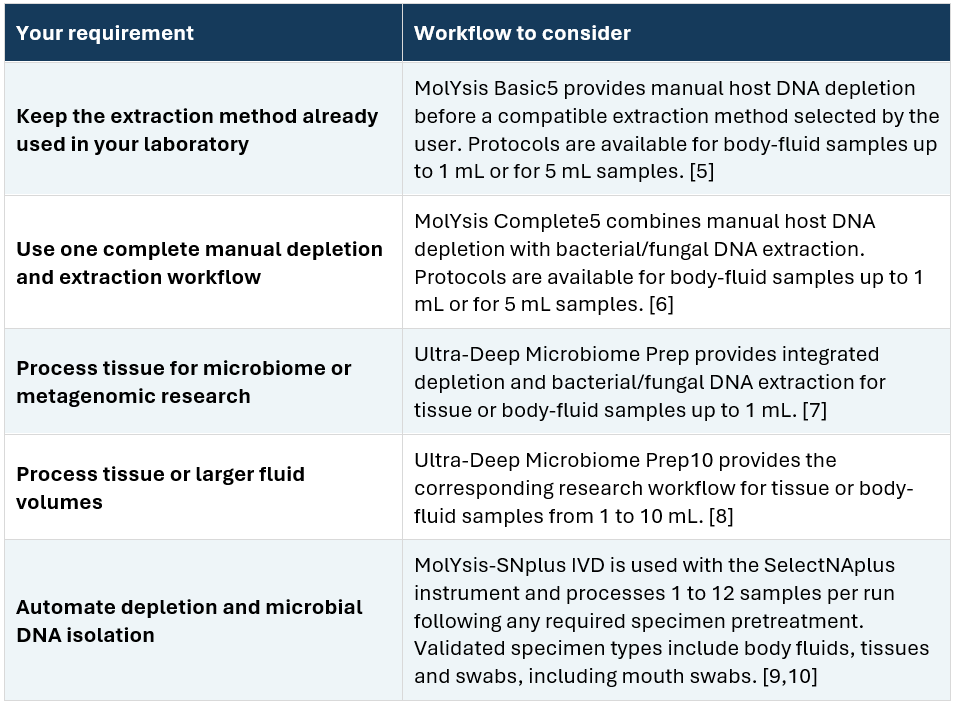
Table 1. MolYsis workflow selection
Why consider a supported MolYsis workflow
No host-depletion method will be optimal for every sample. The value of the MolYsis range lies in the ability to choose between:
- depletion before an existing extraction process;
- a complete manual depletion and extraction workflow;
- workflows designed to accommodate tissue;
- small- and larger-volume fluid protocols; and
- automated IVD processing on the SelectNAplus instrument.
The relevant question is not whether one method achieved the greatest depletion in a single published comparison. It is whether a repeatable, supportable workflow can reduce human reads sufficiently while preserving the microbial information required for your study.
That is best established with your samples, your controls and your downstream analysis.
Bring us the sequencing problem
If your oral samples are producing a high proportion of human reads, send the VH Bio molecular biology team:
- your sample type and approximate volume;
- whether samples are fresh or frozen;
- your current extraction method;
- your sequencing or PCR workflow;
- your approximate percentage of human-aligned reads; and
- the number of samples you expect to process.
We can help you identify the most suitable workflow and the variables to assess during your own pilot evaluation.
Get in touch with the VH Bio team to discuss your workflow or to learn more about the MolYsis range by filling in the form below.
References
- Marotz CA, Sanders JG, Zuniga C, Zaramela LS, Knight R, Zengler K. Improving saliva shotgun metagenomics by chemical host DNA depletion. Microbiome. 2018;6:42. doi:10.1186/s40168-018-0426-3.
- Salter SJ, Cox MJ, Turek EM, et al. Reagent and laboratory contamination can critically impact sequence-based microbiome analyses. BMC Biology. 2014;12:87. doi:10.1186/s12915-014-0087-z.
- Horz HP, Scheer S, Huenger F, Vianna ME, Conrads G. Selective isolation of bacterial DNA from human clinical specimens. Journal of Microbiological Methods. 2008;72(1):98-102. doi:10.1016/j.mimet.2007.10.007.
- Duran-Pinedo AE, Chen T, Teles R, et al. Community-wide transcriptome of the oral microbiome in subjects with and without periodontitis. The ISME Journal. 2014;8:1659-1672. doi:10.1038/ismej.2014.23.
- Molzym GmbH & Co. KG. MolYsis Basic5: Instructions for Use. D-301, Version 09. November 2023.
- Molzym GmbH & Co. KG. MolYsis Complete5: Instructions for Use. D-321, Version 09. November 2023.
- Molzym GmbH & Co. KG. Ultra-Deep Microbiome Prep: Instructions for Use. G-020, Version 07. November 2023.
- Molzym GmbH & Co. KG. Ultra-Deep Microbiome Prep10: Instructions for Use. G-030, Version 06. November 2023.
- Molzym GmbH & Co. KG. MolYsis-SNplus IVD: Instructions for Use. U-300, Version 01. September 2024.
- Molzym GmbH & Co. KG. MolYsis-SNplus IVD: Automated Host DNA Depletion. Product flyer, Version 04 ENG. 2026.
Read more: SelectNA™plus White Paper: Automated Host DNA Depletion for Faster, More Sensitive Pathogen Detection
Enquire about this article
"*" indicates required fields
